EN
EN

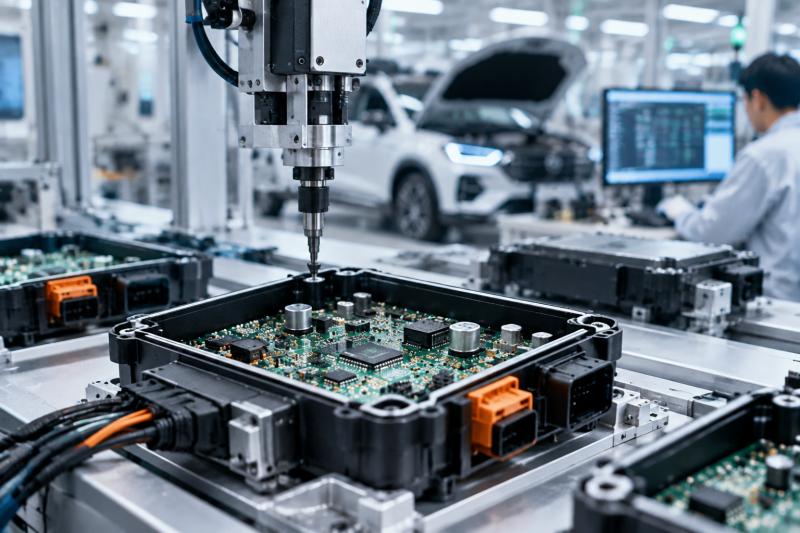
Automotive electronic manufacturing services cover the complete production lifecycle from engineering review and automotive PCBA manufacturing to assembly integration, inspection, validation, and field traceability. A qualified manufacturing partner should control not only PCB assembly quality but also component management, process stability, functional testing, and final product reliability.
For automotive programs, manufacturing excellence is defined by consistent process control, documented traceability, and the ability to prevent failures before products reach vehicles. Professional electronic manufacturing services for automotive applications combine advanced production systems with strict quality management to meet demanding requirements for safety, durability, and long-term supply stability.
A complete automotive electronic manufacturing services solution should include engineering support, PCB assembly, component sourcing, inspection, testing, final assembly, and quality documentation.
Unlike general electronics manufacturing, automotive projects require tighter control over manufacturing processes because electronic modules operate under extreme conditions and often support critical vehicle functions. A capable EMS provider typically manages:
Engineering and DFM review before production
PCB fabrication coordination and component procurement
SMT and through-hole assembly
Automated inspection and electrical testing
Cable harness, enclosure, and mechanical integration
Firmware programming and functional validation
Final product testing and shipment approval
Production traceability and quality reporting
The manufacturing partner should act as an extension of the customer's engineering and supply chain teams, reducing production risks from prototype builds through mass production.
Automotive electronic products often require more than PCB assembly. The manufacturing scope may include:
PCBA manufacturing: SMT placement, soldering, inspection, programming, and electrical verification
Cable and harness integration: connector assembly, routing, continuity testing, and labeling
Enclosure assembly: mechanical installation, sealing, fastening, and protection validation
Final box build: complete product integration, functional testing, and packaging
The right production model depends on product complexity. Some customers require a dedicated automotive PCBA manufacturing partner, while others prefer a full-service provider capable of delivering complete electronic assemblies.
Automotive electronics must survive conditions far beyond typical consumer products. Manufacturing processes must address:
High temperature exposure from engine compartments and battery systems
Continuous vibration and mechanical stress
Moisture, dust, and chemical exposure
Voltage fluctuations and electrical transients
Process controls such as solder profile management, conformal coating application, sealing verification, and mechanical inspection help prevent failures caused by environmental stress.
For electronic manufacturing services for automotive, reliability is built into every production stage rather than tested only at the end.
Automotive products often remain in service for many years. Manufacturers must control:
Component availability and lifecycle status
Approved supplier sources
Alternative component qualification
Manufacturing history tracking
When a field issue occurs, traceability systems allow manufacturers to quickly identify affected production batches, components, and process conditions.
Before production begins, a professional EMS provider performs Design for Manufacturing (DFM) analysis to identify potential production risks.
Key review areas include:
PCB layout manufacturability
Component placement limitations
Solder joint reliability
Thermal management requirements
Test point accessibility
Assembly complexity
Critical characteristics related to safety, electrical performance, or durability should be clearly identified and controlled throughout production.
Automotive programs require strict control of product revisions and materials.
Manufacturing teams should maintain:
Approved component lists
Engineering revision records
Material specifications
Authorized engineering changes
Unauthorized substitutions or undocumented changes can create significant reliability risks in automotive applications.
Standardized work instructions ensure every production step is performed consistently.
Effective controls include:
Visual assembly guidance
Torque requirements
Inspection checkpoints
Operator training records
Process verification procedures
These controls reduce human errors and improve repeatability during high-volume manufacturing.
A reliable automotive PCBA manufacturing process uses multiple inspection methods because no single test can identify every defect.
Typical inspection coverage includes:
Automated Optical Inspection (AOI) for placement and solder defects
X-ray inspection for hidden solder joints and BGA connections
Solder paste inspection (SPI) for printing quality
Visual inspection for assembly compliance
Combining inspection technologies improves defect detection and reduces downstream failures.
Electrical testing verifies whether assemblies meet design requirements.
Common testing methods include:
In-circuit testing (ICT)
Boundary scan testing
Programming verification
Functional testing
Communication protocol testing
The test strategy should match product requirements, including CAN, LIN, Ethernet, sensor interfaces, and other automotive communication systems.
Some automotive applications require additional validation, such as:
Thermal cycling
Vibration testing
Humidity testing
Power cycling
Aging tests
These tests help confirm product durability under real operating conditions.
Automotive customers typically require complete manufacturing records, including:
Component batch information
Supplier records
Production dates
Assembly revisions
Inspection results
Strong traceability supports warranty analysis, quality improvement, and regulatory compliance.
A professional EMS partner should maintain structured quality improvement processes, including:
Nonconformance reports (NCR)
Root cause analysis
Corrective and preventive actions (CAPA)
Process improvement records
These systems ensure production issues are resolved permanently rather than temporarily corrected.
Selecting an EMS provider requires evaluation beyond equipment capability. Automotive buyers should assess:
Experience with automotive electronic manufacturing services
Quality management systems and certifications
SMT production capability
Testing capability
Supply chain control
Engineering support resources
Production scalability
A strong partner should demonstrate experience managing automotive requirements from prototype validation to stable mass production.
Before requesting a quotation, buyers should prepare:
Product specifications and application environment
PCB files and assembly drawings
Bill of Materials (BOM)
Approved component requirements
Annual volume forecast
Required testing standards
Packaging and labeling requirements
Quality documentation expectations
Providing complete RFQ information enables manufacturers to evaluate cost, process requirements, and production risks accurately.
Manufacturers usually need PCB files, BOM, drawings, specifications, forecast volume, and testing requirements to prepare an accurate quotation.
Automotive electronic manufacturing services providers maintain traceability through component lot records, production data, inspection results, and revision tracking systems.
Required tests depend on product function but may include AOI, X-ray, ICT, functional testing, and environmental validation.
Yes. Many EMS providers offer integrated automotive PCBA manufacturing and final assembly services to simplify supply chain management and quality control.